
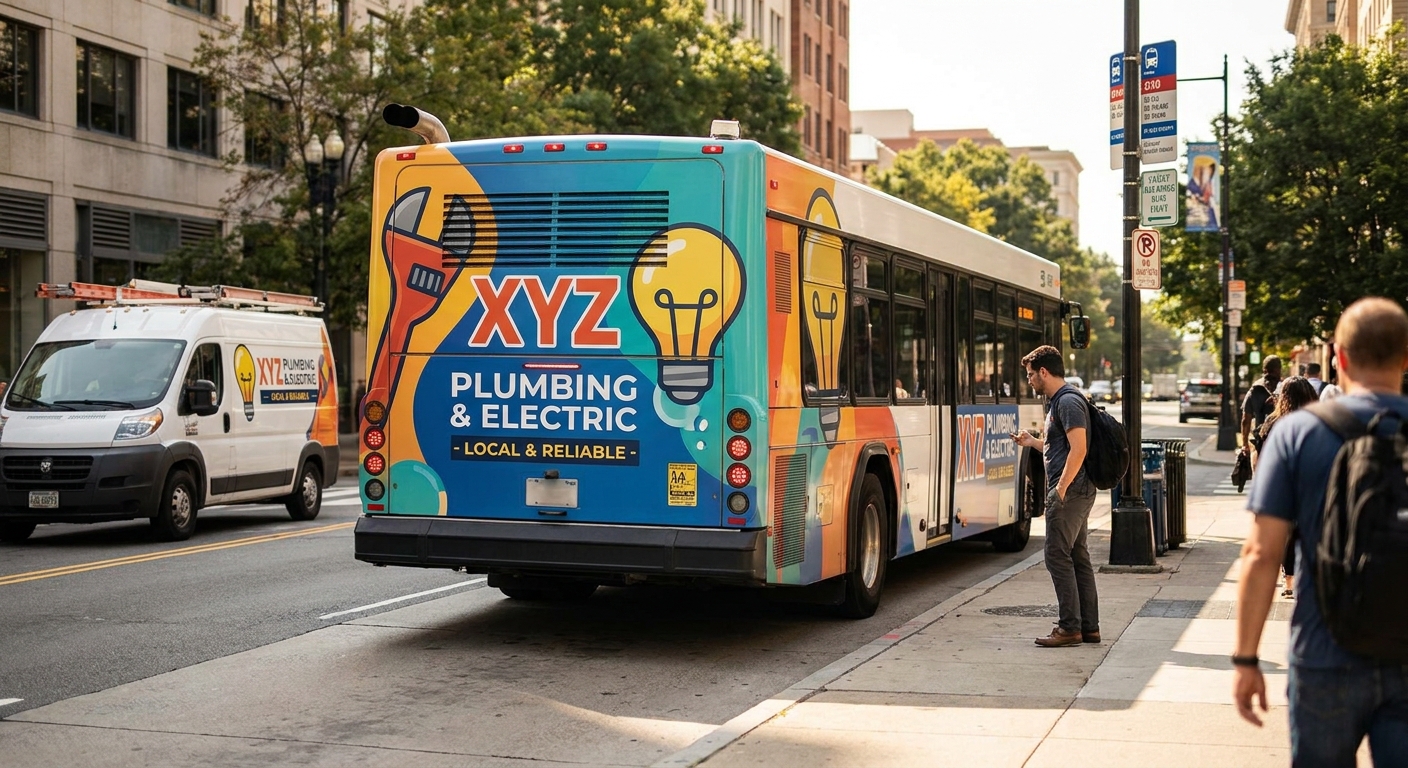
Transit advertising puts your logo on a bus, a shelter panel or a fleet ute in front of thousands of local eyes a week, but most trades businesses buy the wrong format and never trace a single job back to it. This guide breaks down which transit formats actually work for a plumber, sparky, landscaper or builder running a 20-40km service radius in 2026, and which ones just burn budget.
- Bus wraps win for trades with a defined local service area and a 3-month minimum budget - buy for route coverage, not city-wide reach.
- Vehicle and ute signage on your own fleet is the cheapest transit advertising for local business you'll ever run - it's already paid for.
- Bus shelter panels are the budget entry point for trades under $1,500/month, but only near job-dense suburbs.
- Skip single-panel one-off placements and airport transit ads - wrong audience, no repeat exposure.
- Pair any transit format with a tracked phone number or QR code or you'll never know if it worked.
Why this matters
Transit advertising works differently for a national retailer than it does for a trade business covering three or four suburbs. A retailer buys reach. A trade business needs frequency inside a tight geography - the same commuters seeing the same ute or bus panel week after week until the name sticks for the next blocked drain or tripped switchboard.
Most local operators get pitched a "city-wide bus campaign" by a media rep and pay for exposure in suburbs they'll never quote a job in. Webrr Digital builds transit advertising into a wider local growth plan - alongside SEO, Google Ads and a CRM that actually logs where the call came from - so the media spend maps to the streets you service, not the whole metro area.
Who this is for
This guide is for owner-operators and small trade businesses - plumbing, electrical, HVAC, landscaping, building - running one to five vehicles and quoting jobs inside a defined local patch. If you're already booked out six weeks and don't need more lead volume, transit advertising isn't your next move. If you're trying to build recognition across a specific council area or a cluster of suburbs, it's worth a serious look in 2026.
What to look for in transit advertising for trades businesses
Route or route-cluster coverage, not city-wide packages
A trade business doesn't need a bus running across the whole metro grid - it needs the two or three routes that actually pass through the suburbs it services. Ask the media owner for a route map before you sign, not just an impressions number.
Cost against your average job value, not against "reach"
A $2,000 bus shelter booking only makes sense if it can plausibly generate a couple of jobs worth more than that over the campaign. Run the math against your actual average job value in 2026, not against a media kit's impressions claim.
Production and install lead time
Bus wraps and shelter panels typically need 3-4 weeks from artwork sign-off to install, and most transit operators require a minimum 3-month booking. If you need leads next month, transit advertising is the wrong lever - it's a brand-building play, not a fast-response one.
A tracked phone number or QR code baked into the creative
Without a dedicated tracked number or a QR code pointing to a specific landing page, you have no way to attribute calls to the campaign. This is the single most common mistake trades businesses make with transit advertising.
Compliance and council/operator approval
Vehicle wraps, shelter panels and any transit signage go through operator and sometimes council sign-off before install. Build 2-3 weeks into your timeline for this, and confirm size, colour and content restrictions upfront - rejected artwork after production is a wasted booking.
Plan your local ad mix for 2026
Get transit, search and paid ads mapped to the suburbs you actually service.
Top picks for local trades businesses
Bus wraps (full or partial) - the workhorse pick. A partial wrap covering both sides of a bus running your service suburbs delivers repeat daily exposure to the same commuters, and most operators set a 3-month minimum term. One spec that matters: partial wraps (rear and side panels) run noticeably cheaper than full wraps and still get 70-80% of the visibility for daily commuters. Buy if two or more of your target suburbs sit on a single route.
Bus shelter panels - the budget entry point. Shelter panels sit at eye level for foot traffic and drivers stopped at lights, and bookings often start from a single 4-week cycle in high-density corridors. The catch: reach is limited to whoever passes that specific shelter, so you need 3-4 shelters clustered near job-dense suburbs to get real coverage. Consider if your budget is under $1,500 a month and you can commit to a cluster, not one panel.
Vehicle and ute signage on your own fleet - the pick you already own. A well-designed decal set across a 3-vehicle fleet running local jobs daily puts your brand in front of the same streets your customers live on, at zero ongoing media cost after production. This is the cheapest form of transit advertising for local business going, because you're not renting the space. Buy - there's no version of a trades business where this isn't worth doing first, before any paid transit media.
Taxi and rideshare wraps - the wildcard. Taxi wraps put you in front of a different audience - people without their own car, often in denser inner suburbs - and campaigns can run month-to-month rather than the 3-month minimums bus operators demand. The trade-off is unpredictable route coverage; taxis go where the fares go, not where you want them. Consider only if your service area overlaps a dense inner-suburb taxi rank zone, otherwise skip.
Train station platform and concourse ads - the reach play. Station panels reach commuters during dwell time, often 5-10 minutes standing on a platform, which is longer attention than a moving bus gets. But station campaigns are typically priced for regional or city-wide advertisers, not a single-suburb trade business, and the minimum spend rarely justifies the local return. Skip unless a major station sits inside your core service suburb.
Comparison table
| Format | Best for | Minimum commitment | Verdict |
|---|---|---|---|
| Bus wrap (partial) | Multi-suburb route coverage | 3 months | Buy |
| Bus shelter panel cluster | Budget under $1,500/month | 4 weeks per panel | Consider |
| Vehicle/ute signage | Every trade business, any budget | One-off production | Buy |
| Taxi/rideshare wrap | Dense inner-suburb overlap | Month-to-month | Consider |
| Train station panel | Regional or city-wide brands | 3+ months, high spend | Skip |
What to avoid
- Single one-off panels. One shelter panel for one month builds no frequency and no recall - budget for a cluster or a longer run, not a one-off.
- City-wide "awareness" packages. These look good in a media kit but waste spend on suburbs outside your service radius. Insist on a route map.
- Any transit buy with no tracked number or QR code. If you can't attribute a call to the campaign, you can't tell if the 2026 spend is working or just sitting on a bus.
FAQ
What's the best transit advertising for local business owners in 2026?
Vehicle and ute signage on your own fleet is the best starting point because it costs nothing ongoing and covers the exact streets you already work. Bus wraps come next once you can commit to a 3-month booking on routes that hit your service suburbs.
Is bus advertising better than shelter panels for a trades business?
Bus wraps generally beat shelter panels because they cover multiple suburbs on one route rather than one fixed location. Shelter panels only make sense clustered across 3-4 sites near job-dense areas, not as a single panel.
How much does transit advertising cost for a small trades business?
Shelter panel bookings can start from a single 4-week cycle, while bus wraps usually require a 3-month minimum term at a higher monthly rate. Vehicle signage on your own fleet is a one-off production cost with no ongoing media fee.
How long does it take to launch a transit advertising campaign?
Budget 3-4 weeks for artwork production and install after the operator approves your creative. Council or operator compliance sign-off can add another 2-3 weeks, so start the process 6-8 weeks before you need the campaign live.
Can I track leads from a bus wrap or shelter panel?
Yes, but only if you build a dedicated tracked phone number or QR code into the creative before it goes to print. Without one, calls and visits can't be attributed back to the transit campaign.
Should a plumber or electrician bother with transit advertising in 2026?
It's worth it if you're trying to build recognition across a defined set of suburbs and can commit to a 3-month minimum. If you're already fully booked, spend the budget on retention or SEO instead.
Is taxi advertising a good fit for local trades?
Only if your service area overlaps a dense inner-suburb taxi rank zone, since taxi wraps follow fares rather than fixed routes. For most outer-suburb trades businesses, bus routes give more predictable coverage.
What's the biggest mistake trades businesses make with transit ads?
Buying a city-wide package instead of confirming the actual route map, which wastes spend on suburbs outside the service area. The second biggest mistake is skipping call tracking, which leaves no way to prove the campaign worked.
One last thing
The trades businesses that actually get calls from transit advertising are the ones that treat the wrap or panel as the top of a funnel, not the whole funnel - the ad drives a tracked number or a QR code to a page built for that specific campaign, not the homepage. Skip that step in 2026 and you'll have a nice-looking bus with no way to prove it earned its keep.